Cookie Policy | Sitemap
Shri Chaitanya Sridhara Sangha

Srila Bhaktivinoda Thakura
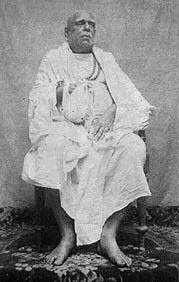
Srila Bhaktivinoda Thakura was born in 1838 in the village of Birnagar, located in the ancient district of Nadia in West Bengal, and at birth he was given the name Kedaranatha Datta.
He can be considered the pioneer of the modern Hare Krishna Movement because among his merits is that of having revealed, around 1890, in Nabadwip-dhama, the exact place of birth of Sri Chaitanya Mahaprabhu, after many years of research and documentation, with great effort and by divine inspiration, supported by numerous scriptural evidences.
Just 300 years after the advent of Sri Chaitanya Mahaprabhu his message had practically died out. Altered by impure and misleading interpretations, it was by then considered only as a scarcely spread tradition practiced by mendicants without any morality. Furthermore, the British occupation contributed to this decline by propagating Vedic knowledge as a mere collection of superstitions and rituals.
Srila Bhaktivinoda Thakura re-established the worship of Sri Krishna in the proper way, ensuring, thanks to his position as an influential magistrate, that the intelligent class of India became properly aware of it.
He indicated exclusive surrender (saranagati) to the service of the Lord's pure devotees as the essence of devotion and for this purpose composed, in an analytical, simple, and attractive style, a large number of books, prayers, poems, and commentaries in Sanskrit, Bengali, Hindi, and English which, even at that time, were appreciated by academic institutions outside India.
Although he came from a very wealthy family, Kedaranatha Datta had a difficult childhood because gradually his family lost all their wealth and went into debt.
He was nevertheless educated in the various aspects of religion and became a very brilliant scholar, endowed with great willpower. In March 1868, he obtained the position of magistrate, which was the highest position that could be reached by an Indian in the British occupation government.
He soon became famous for his intellect, honesty, and balanced judgments. During his career as a magistrate, he was transferred to various locations and, having the reputation of being an expert in the Sacred Scriptures, was often called upon to decide on religious matters that could potentially have significant political and social implications.
As a result of his constant commitment to spreading the teachings of Sri Chaitanya Mahaprabhu, some prominent vaishnavas at that time, impressed by his scholarship and dedication, conferred upon him the title of “Bhaktivinoda” which means “one who attains happiness through bhakti.” From then on he was known as Sad-cid-ananda Bhaktivinoda Thakura.
Srila Bhaktivinoda was the perfect example of family life conducted in Krishna consciousness. He performed his material duties efficiently and sincerely and, as head of the family, took care of his loved ones, ensuring their proper spiritual development.
He ardently prayed to have a son who could continue his work.
The Lord satisfied him in 1874, when Bimala Prasada Datta was born, who would later be known as a point of reference among the Gaudiya Vaishnavas by the name of Srila Bhaktisiddhanta Sarasvati Thakura. In the years that followed, he traveled extensively spreading the message of Sri Chaitanya Mahaprabhu throughout India.
In 1914 Srila Sac-cid-ananda BhaktivinodaThakura departed from this world.
TELEPHONE NUMBER:
0039 339 1776150
ADDRESS:
Vocabolo Madonna degli Angeli snc - 02046 Magliano Sabina (RI) - ITALY
E-MAIL:
info@scsridharasangha.org